Kelly Waltrich, Author at Intention.ly - Page 4 of 6

Marketing leaders, tell me if you’ve been here before:

Your CEO sets an MQL lead goal of {insert absurd number here}, without giving you any context for how that number is expected to impact the business.

In reality, it’s an exercise to keep your team and the sales team busy. This becomes even more apparent when the goalposts keep moving quarter after quarter until unreasonable becomes unrealistic and unrealistic becomes impossible.

We’re not accepting this in 2025.

Instead, I’m going to give you a simple but highly valuable formula for setting proper, attainable lead generation goals that also drive results for your business.

First, identify your firm’s revenue targets for the year, as well as your average deal size. For example:

» Revenue goal: $2,000,000

» Average deal size: $50,000

Next, divide revenue by average deal size to calculate the number of deals you need to close: 

» $2,000,000/$50,000 = 40 deals

Take that number and divide it by your close rate to determine number of leads:

» 40/20% = 200 leads 

Now you have the number of leads you need to meet your revenue target. Personally, I like to add 5-10% to this number to make sure I’m giving my team a bit of cushion and setting them up for success.

Obviously, for more complex businesses this exercise gets more intensive. You may need to account for multiple business lines, include upsell and cross-sell opportunities, or deduct churn numbers from your revenue.

It should go without saying, but it often doesn’t, that reaching your new, appropriate lead goal number is contingent on establishing the right budget based on customer acquisition cost (CAC).

Here’s a quick rundown of how to calculate that:

→ First, CAC doesn’t just mean the actual dollar amount spent on digital advertising. It needs to include the cost of your marketing and sales teams, plus any technology and tools used to support your lead generation efforts.

→ For the sake of round numbers, let’s say your total CAC is $1,000. Continuing with our example from above: $1,000 x 200 leads = $200,000.

That’s the absolute minimum budget from which you can be expected to drive the leads your business needs to reach its revenue goals. I always advocate for additional spend to account for unexpected initiatives, priority changes, and major surprises in the market. 

Call me a nerd, but I love working with businesses to get these numbers right – even (especially!) the super complicated ones. If you want some help nailing down the right lead generation goals and accompanying budget for your 2025 objectives, shoot me a message and let’s have a conversation!


As we approach the end of the year (!), I’ve spent a lot of time talking with my team and our clients about what they can do now to hit the ground running in 2025. 

One of the most overlooked but wildly important elements of a firm’s success is determining how leadership is going to be measured – marketing leaders in particular. Often, CMOs are held to hazy objectives or subjected to constantly moving goalposts, making it nearly impossible to point to the impact of marketing on the organization’s broader goals.  

Having worn the CMO hat myself, I know how difficult it is to do the job without knowing exactly what I’m working towards – and how motivating it is when I do. 

If you’re unsure about how to measure your marketing leader’s success, I’ve broken down five ways to do so:

1. Contribution to revenue: The first is probably the most important – and to be very clear, your marketing leader should want to be measured against the impact he or she has on revenue. That’s the sign of someone who understands the role marketing is supposed to be playing, and who has skin in the game when it comes to driving real business results.

Scoring against this goal requires setting up meticulous reporting and analysis (for both the marketing AND the sales team) of critical metrics like pipeline generation, lead response time, customer acquisition cost, and sales cycle length.

2. Lead generation: I don’t recommend this as a measure of success unless you’re selling into a large number of firms and executing pure volume plays to drive growth. If that applies to you, use your revenue goals and average sales close rate to determine how many leads per month you’ll need marketing to bring in.

Be sure the number you give them is realistic – otherwise, you’re setting the team up to fail OR to generate junk leads in pursuit of their goal, which only breeds animosity and mistrust between sales and marketing functions.

3. Opportunities and connections: Volume goes out the window when your firm is focused on selling into a few large enterprises rather than boiling the proverbial ocean. In this case, your marketing leader should be goaled on their team’s ability to create demand within these organizations, gain visibility with top executives, and tee up opportunities for the sales team to take across the finish line.

Sales and marketing alignment is always important, but it becomes especially so when organizations are hunting big enterprise deals. These teams need to work in lockstep to develop pitches, sales enablement resources, and messaging that reflects the conversations sales is having within these key accounts.

4. Audience growth: Your marketing team should be able to not only generate awareness for your firm, but also turn that attention into audience expansion and community-building through a consistent flywheel of educational content, compelling events, thought leadership and a highly active social media presence.

Social media followers and newsletter subscribers are basic barometers of audience growth, but you should also be looking for increases in unique website visits, branded traffic, engagement with emails,  and webinar and event attendance. As your audience grows, you should also see related indicators like shorter sales cycles and lower customer acquisition cost.

5. Growth of wallet share within existing clients: Client success, retention and expansion can’t just fall to your customer support function. Good marketing leaders understand the wealth of opportunities represented by your existing client base, from the ability to tap into case studies and testimonials to upsell and cross-sell promotions that not only add to the bottom line, but also create additional stickiness for the business.

Ideally, your marketing leader will be goaled on all or most of these objectives – and if they are, their compensation should be set accordingly. Define your marketing leader’s goals, communicate them clearly, and work together to set the team up for success.

Need more help? I absolutely love talking about how to maximize the potential of marketing, and I’ll always be an advocate for CMOs in this industry. Grab some time on my calendar here!


In my role at intention.ly/, I’ve had the opportunity to help a number of firms build or optimize their in-house marketing teams, many of whom were also orchestrating outsourced work across multiple agencies. And I’ve learned there’s a distinct formula for success when it comes to the timing of who to hire in house and what to outsource. 

The order of hiring, while contingent on budget and resources, has to be prescriptive and directly correlated to the level of sophistication your firm is ready to handle in-house versus leaning on the expertise of an outsourced agency to guide your marketing efforts.

See below for a rough sketch to work from.


Phase One

In-House Roles

Agency Roles

  • Marketing generalist focused
    on execution: social media, email,
    potentially light blog posts
    and landing pages 
  • Marketing strategy
  • Content
  • Design
  • Digital marketing/paid media


Ideally, you’ll work with an agency that can expertly handle all of the above. In this stage, marketing strategy could also be managed in house by a marketing-minded business leader, likely the founder.

Perhaps the most important thing you’ll do in this phase is establish the metrics that will guide your ongoing efforts. These KPIs need to be communicated effectively across your in-house and agency teams so everyone can work in sync toward the same goals.


Phase Two

In-House Roles

Agency Roles

  • Marketing generalist
  • + Content 
  • + Design
  • Marketing strategy
  • Digital marketing/paid media
  • Marketing operations
  • Extra support


By this stage, you can begin putting together and publishing assets in house, starting with a content specialist and adding a designer when you’re ready. Your agency can guide your strategy, optimize your digital efforts, and, in this phase, establish a solid foundation for your marketing operations to keep your lists and processes organized.


Phase Three

In-House Roles Agency Roles
  • Marketing generalist
  • Content
  • Design
  • + VP of Marketing
  • + Marketing operations
  • Marketing strategy
  • Digital marketing/paid media
  • Extra support 


Your VP of marketing should be a master manager of people and agencies, coordinating collaboration and campaign execution. He or she should be able to provide light strategy guidance, but at this stage, you’ll still need an agency for overall strategy, digital marketing, and extra support where necessary. 

In this phase, I also recommend bringing marketing operations in house. As your marketing efforts ramp up and lead generation accelerates, keeping your workflows streamlined, your lists clean and organized, and your marketing-to-sales handoff process seamless becomes even more critical. If I could do just one thing differently as I was building an internal team, it would be to hire marketing ops sooner!


Phase Four

In-House Roles Agency Roles
  • Marketing generalist
  • Content 
  • Design
  • VP of Marketing
  • Marketing operations
  • + Chief Marketing Officer (CMO)
  • + Demand generation
  • Digital marketing/paid media
  • Extra support


It’s time to bring strategy in house under the leadership of a CMO — and strategy is the key here, as a lot of organizations will hire CMOs who are more adept people managers than true strategic visionaries. You’re looking for a complementary partnership between a CMO who can manage up, earning a seat at the leadership table, and a VP of Marketing who can manage down, keeping the day-to-day tactics in motion and optimized.

In this stage, the marketing generalist is either phased out or steps into a more specialized role on the team.


Phase Five

In-House Roles Agency Roles
  • Content 
  • Design
  • VP of Marketing
  • Marketing operations
  • Chief Marketing Officer (CMO)
  • Demand generation
  • + Events
  • Digital marketing/paid media
  • Specialized strategic consulting
  • Extra support


At this stage, your marketing engine is humming; if events are part of your firm’s overall growth strategy, you’ll want to add an events specialist to optimize your presence and maximize that fairly expensive investment. 

You’ll notice we still recommend outsourcing digital marketing, even for the most sophisticated and mature marketing organizations. Here’s why: by this phase, a good digital marketing agency will know the nuances of your business, your target audience, and your competitors’ campaigns inside and out. That means they can effortlessly fine-tune campaigns and critical metrics like cost per lead and client acquisition cost to help you make the most of your budget. Most agencies also have greater visibility into the competitive landscape than your in-house team does, giving you an extra advantage.

At this point, you might also want to consider retaining an agency for specialized support conceptualizing and executing innovative strategies outside of your typical campaigns. Think of this as a consulting partnership to amplify your already high-performing marketing efforts.

Finally, I don’t think there’s a single phase in your growth journey wherein you wouldn’t benefit from extra support. As you hire, build your team, and continue evolving your business, you’re going to need extra hands to fill gaps and keep your engine running smoothly. This is where an agency that’s built to scale up and down with your firm becomes an invaluable extension of your team.


Are you happy with what you’re paying your marketing agency for leads? For leads that convert to clients?

If you answered ‘yes,’ – why?

I’ve spoken with a number of prospects recently who have no problem paying what we know are exorbitantly high cost-per-lead and client acquisition costs – simply because they don’t know any better.

On one particular call, we realized this prospect was paying a staggering 10 times more than their peers for the same quality of leads.

This tells me one of two things is happening:

  • Either the agency has no idea how to optimize CPL and client acquisition cost (CAC)
    -OR-
  • The agency is taking advantage of them.

This is why it’s so wildly important to understand the CPL and CAC benchmarks for the types of clients you’re trying to attract, especially if you’re outsourcing your digital marketing.

At the minimum, be able to answer these questions:

  • What should you be paying for a lead?
  • What percentage of those leads should you expect to convert if you, along with your agency, are running a well-optimized marketing engine?

In my in-house marketing leadership roles, I always held my team accountable to meeting or exceeding the benchmarks of metrics that actually matter. I think it’s even more important for us to do the same thing at intention.ly/. Firms trust us with their growth goals and their budgets – it’s our obligation to do what’s best for them.

Kelly Waltrich is Co-Founder & CEO of intention.ly/. Contact her with question. 

I was talking to a firm recently that wanted feedback on their marketing strategy. But when I asked them to back into how they arrived at the strategy itself, they couldn’t tell me:

➡️ Exactly what happens to leads when they hit their CRM
➡️ How quickly prospects are moving through the pipeline
➡️ Whether acquisition costs are trending up or down
➡️ Which channels are driving the best opportunities
➡️ What objection reasons are being given when opportunities move to closed-lost
➡️ The questions prospects are asking in sales meetings
➡️ The competitors they’re losing to, and why

How can you develop or refine a marketing strategy without knowing anything about what’s driving business or causing deals to stall? Marketing strategy is predicated on a constant flow of timely customer and performance insights from across the business.

If you’re running marketing in house, it’s vital to eliminate the silos between departments, particularly sales and marketing, that prevent the transfer of this information.

And if you’re working with a marketing agency, you need to be collecting and sharing this type of data with them. Otherwise, they’ll be forced to develop your strategy in a vacuum – and good marketing is never built on assumptions.

Kelly Waltrich is Co-Founder & CEO of intention.ly/. Contact her with question. 

Your marketing team – whether in house, outsourced, or some combination thereof – is arguably the single most important tool you have for driving growth at your firm. (I may be slightly biased, but I’m not wrong 😉).

Which makes hiring your marketers a critical decision for the future of your business.

The problem is that “marketing” has become a catch-all term for what actually encompasses a number of different skill sets and competencies, including but surely not limited to:

💪 Execution ninjas, highly skilled at implementing marketing tactics
🖼 Creative specialists like copywriters and designers
📊 Paid digital and demand generation experts
🤸‍♀️ Generalists that dabble in a little of this and a little of that
🦄 The very rare unicorn who can do it all — strategy and execution

There’s also what I like to call the people manager, someone adept at facilitating projects or hiring and working with agencies, but lacking any real strategic and tactical ability.

With all of these important but different proficiencies falling under the umbrella of marketing, it’s dangerously easy to pull the trigger on the wrong person, particularly if you or your hiring team aren’t deeply versed in the nuances of marketing orchestration.

Hiring the wrong marketer for your business’s needs and goals isn’t just costly and frustrating. It can also lead you to believe that marketing doesn’t work and therefore you don’t need it – and you can’t make a bigger business mistake than eliminating marketing.

So before you even think about opening a job rec on LinkedIn, consider these questions:

  • What does your business need from this role?
  • What are your growth goals for the next one to five years?
  • How do you envision this person supporting those goals? Be specific.

Use the answers to these questions to craft your job description. And as you begin evaluating candidates:

  1. Look for proven success driving growth for businesses like yours and in the same stage as yours.
  2. Don’t be afraid to test candidates as part of the interview process, especially if you’re looking for a creative expert or someone to drive strategy.
  3. Ask for referrals and use them. Make sure you’re not getting a people manager masquerading as an execution ninja.
  4. Consider using a consultant to help you identify which candidate is which, and what you really need for your business.
  5. Dig extra deep on the folks who claim they can do it all.  In my experience that’s 1% of marketers or less and you’re likely being punked.

Don’t let the wrong marketing hire derail your growth efforts. Spend the time up front to understand the skills and expertise you really need, and don’t settle until you find it.

🔔 Contact me if I can help you avoid this business booby trap.

Kelly Waltrich is Co-Founder & CEO of intention.ly/

Listen to the full episode here.

With digital disruptions and shifting customer expectations defining the financial landscape, achieving sustainable growth demands a strategic approach that transcends traditional marketing tactics. For forward-thinking financial services firms, the challenge lies in creating a framework that seamlessly integrates marketing and growth strategies, prioritizing brand differentiation and customer-centric value creation.

In this episode, Jack talks with Kelly Waltrich, Co-Founder & CEO of intention.ly/. For years, Kelly has been championing the role of marketing in the financial services industry. She designed the strategy behind several successful rebrands, acquisitions, and product launches, including spearheading the development of two advisor marketing products while creating unmatched overall brand visibility and helping to turn company executives into industry thought leaders. Through forward-thinking demand generation, PR, and product marketing, Kelly created a consistent inbound pipeline for both firms, driving CAC down and SOV up.

Kelly talks with Jack about modern marketing and growth strategies in the financial services industry. She shares how intention.ly/ helps firms build growth engines and differentiate themselves in a crowded market. Kelly emphasizes the need for firms to have a strong brand and messaging that resonates with their target audience.

Over the summer, we had a client ask our team to put together a brand awareness campaign targeting a cold group of prospects. No problem, we do that all the time. The client had little to no budget for paid channels, so the bulk of our efforts were going to need to be executed organically and via email. And from the time the campaign launched, the client added, they wanted to see substantial results in 30 days.

Now there’s a problem. My team tried to explain that a month is simply an unrealistic time frame to expect significant results from any digital campaign, particularly one focused on brand awareness targeted to a cold audience, without the ad dollars necessary to accelerate visibility in critical channels. The client insisted. The campaign needed to produce high-quality leads in 30 days, clamoring to purchase their $40K+ ACV software.

Unfortunately, this isn’t a unique or isolated situation. Marketing continues to be misconstrued as a magic button that can just be flip-ped on, opening the floodgates to a pipeline of prospects eager to buy.

In fact, several times a week I paraphrase Joe Pesci’s iconic line in My Cousin Vinny: “Perhaps the laws of marketing cease to exist at your firm?” This pervasive misconception about marketing’s role, which often transcends the executive level, does real damage in two important ways:

1. Marketers are forced to act on short-term tactics that aren’t scalable, sustainable, or aligned with business goals.

2. The business itself misses out on the powerful, ongoing impact created by true marketing.

This is a good place for me to point out that quick wins do play a critical role in marketing success. The sign of a great marketing leader is being able to balance the right short-term initiatives with setting, executing, and optimizing a long-term strategy. When it’s done right, your firm’s marketing function should be responsible for:

• Understanding your target audience’s needs.

• Inspiring them to think differently about how they’re approaching their challenges.

• Building trust and brand affinity with educational content that helps them solve a problem or reach a goal.

• Creating demand for the solution you provide in service of their needs.

• Making it effortless for them to choose your firm when they’re ready to make a purchase.

The truth is, when you approach marketing with a long-term view, your short-term and ongoing results improve. Sending spam emails to pump up pipeline volume over a month-long period isn’t going to do anything except get your business sent to HubSpot jail. But executing marketing with the expectation of building a compounding growth engine over time will make everything more effective:

• Prospects will be much closer to a decision when they get to sales, because you’ve educated them through their buying journey.

• Sales cycle length and customer acquisition cost will decrease, because you’ve spent time building a foundation of trust and brand affinity.

• Word-of-mouth and referral traffic, the holy grail of marketing, will skyrocket, because you’re helping your audience solve critical business challenges with your marketing content.

• Retention will improve because you’re targeting the right people with the right message.

Another client we’ve been working with for some time on advisor recruitment marketing had some initial doubts when our engagement first began. He wasn’t seeing the interest from advisors as quickly as he’d expected. But he stayed the course, giving my team the time to do what they’re so good at doing. Fast forward 16 months, and he’s now petitioning FINRA to allow his firm to grow faster than regulations allow because advisor interest is so high. Changing your mindset about marketing will transform your results. Just not overnight.

Listen to the full episode here.

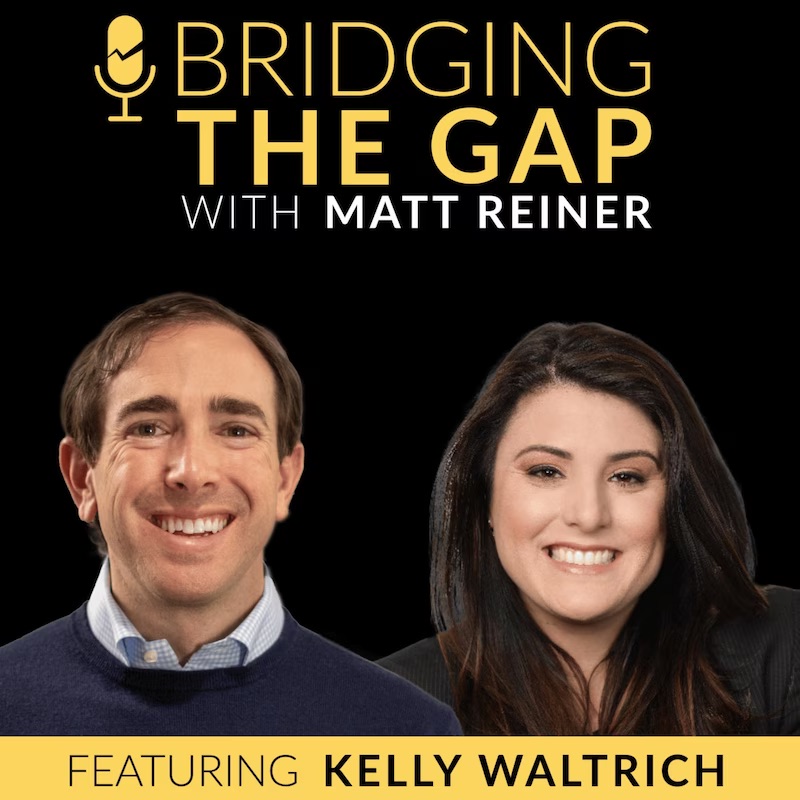
This week on Bridging the Gap, Matt dives into the intricate world of marketing with Kelly Waltrich, former Chief Marketing Officer at eMoney Advisor and Orion Advisor Solutions, now CEO and Co-Founder at intention.ly/, Fintech and Martech Advisor, and Inaugural WealthManagement.com’s CMO of the Year. The conversation kicks off with Kelly’s journey from a thirteen-year-old entrepreneurially-minded individual selling ideas to her grandmother, to her strategic maneuvers through various financial sectors, ultimately leading to the launch of her marketing firm. The narrative chronicles her encounters with prominent fintech companies, emphasizing the significance of purposeful marketing. Her journey mirrors a commitment to continuous evolution and adaptability within the industry. Kelly’s story serves as a beacon for aspiring marketers and financial advisors alike, proving that a deliberate path combined with experience-driven growth is a compelling formula for success.

The episode further explores the common missteps in the financial advisory community’s approach to marketing, highlighting the reluctance to invest in what could be a business’s most potent growth engine. Kelly advocates for a customized approach, dismantling the myth of one-size-fits-all marketing solutions in favor of personalized strategies that resonate. She explores the hurdles encountered in her entrepreneurial path, highlighting the complexities of blending personal relationships with business. Her initial experience, where friends became her inaugural clients, became a pivotal lesson that reshaped her outlook on constructing a resilient business framework.

As the conversation continues, you’ll pick up valuable tips on how to match marketing plans with a company’s growth goals and set clear targets for smart marketing investments. Matt examines different marketing options, delving into how to attract clients and finding a balance between immediate successes and long-term strategies. The episode wraps up with a discussion about the future of financial advice. It touches on blending technology, understanding behavior, and creating customized experiences for different clients. 

Timestamps From This Episode

[00:02:47] Kelly recounts her path from the age of thirteen to the present day.

[00:07:19] Kelly unveils two lessons she had to confront, catching her by surprise with their unforeseen nature.

[00:15:31] Kelly outlines how advisors need to consider awareness versus conversion and how they can reframe their mentality. 

[00:21:44] Kelly shares the lessons she learned while collaborating with Daniel Crosby and the insights she has gathered in the past couple of years on integrating psychology and behaviors into marketing. 

[00:26:52] Matt asks Kelly, “Why do we need to change as an industry?”

[00:35:04] Kelly guides listeners through the implementation of AI in her firm, offering insights into how she envisions its impact unfolding.

[00:38:44] “So I think that people want to be involved in their finances. I think this generation wants to be really hands on and I think that we’re going to have to get creative around the ways that we’re delivering that service.”

[00:42:43] Kelly presents actionable advice for listeners. 

Listen to the full episode here.

What’s your strong suit?

As a financial advisor, you’re juggling more hats than a circus performer – marketing, client relationships, and, of course, your core expertise. But here’s the catch: if you’re trying to handle branding all by yourself, you might be missing out on a difference-maker.

Why blend in when you could stand out?

In this episode, our own Matt Halloran is joined by Kelly Waltrich – co-founder and CEO of intention.ly/ – to unravel the essential role branding plays in the financial services world. Tune in and discover how teamwork, learning, and masterful branding done right can transform your advisory game.

Matt and Kelly discuss:

  • How great advisors are not necessarily great marketers, and why you need to find someone who is an expert
  • The importance of pushing your colleagues – and they, you – to constantly learn new things
  • Why integration in marketing trumps budget or size of firm
  • How coordinated activity is better than massive but disconnected amounts, and the value of asking yourself, “what is helping me get to my goals and the goals of my clients, and what is just noise?”
  • Why  branding needs to resonate internally before you share it externally
  • intention.ly/’s new Advisor Brand Builder tool, and how firms are using it for recruiting and onboarding, amongst other things
  • How to ask the right – aka second and third-level – questions when developing your own brand
  • And more

“And we all do that for each other, which is something I think all businesses should do. Make sure that you’re constantly forcing each other to learn new things.” ~Kelly Waltrich